Reflection of light
Objects can, depending on their material and type of surface, reflect a part of the light that hits them. This process is called reflection.
If (almost) all the light hitting an object is reflected, the object is called a mirror. Depending on the shape and structure of the mirrors surface, one can distinct between flat and curved mirrors and between smooth and rough mirrors.
The plane mirror
Any smooth, flat surface (for example, a smooth metal plate, a still water surface, a window pane, etc.) acts like a flat mirror. While a brightly polished metal surface reflects all the incident light (this is also called total reflection), glass or water reflect only a part of the incident light. Mirrors made of glass are therefore usually painted black on the back or coated with a light-impermeable, dark layer.
The law of reflection
For plane mirrors, one can apply the law of reflection: Every incident light beam leaves the mirror at the same angle as it was incident.
Here is a sketch of the reflection of a light beam at a plane mirror.

The angle of incidence i and the angle of reflection r are specified starting from the perpendicular to the mirror (normal). Mathematically, the law of reflection can be formulated as follows:
i = r
Task 1: Transfer the sketch of the law of reflection to the portfolio. Together, formulate a mnemonic sentence in your own words that summarizes the law of reflection.
Now we want to test the law of reflection in an experiment. You will need:
- An experimental lamp with a power source
- A mirror strip
- A paper disk with circular divisions for reading the angles
Photo of the experiment setup

Task 2: Rebuild the experimental setup in the photo using the materials mentioned. Make sure that the light of the experimental lamp points exactly to the center of the circle. The experiment is to be documented in a protocol. Therefore, you should use the following structure of an experimental protocol as a guide:
After the experiment is set up, please fill in items 1-4 of the experiment protocol.
Task 3: Now successively set the experimental lamp to the angles of incidence in the following table and read the corresponding angle of reflection. Transfer the table to the appropriate place in your experiment protocol and enter the values you read. Complete the remaining points of the experiment protocol.
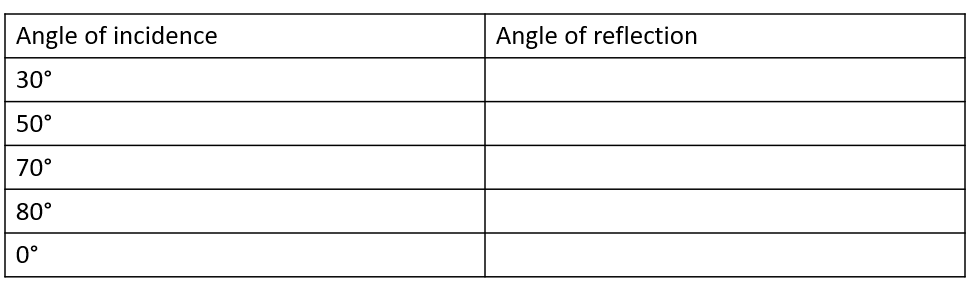
Task 4: What happens to the light beam at 0°? Where is it reflected? Discuss this in the group and write down ideas in your portfolio.
Task 5: Now take a second experimental light. Keep the first one aligned at 80°, then set up the second one at 20°. How are both beams reflected? Describe your observation in the portfolio.
When we look into a mirror, countless lightbeams hit its surface at different angles. All these lightbeams are reflected and fall into the eye of the observer, where they create an image. Let’s take a closer look at that now.
 Lights on!