For those who would like to work on the design assignment on mirrors, there are even more experiments to try. First of all, we take a look at the juxtaposition of two mirrors.
a) What do you think happens when you stand between two mirrors? Make assumptions and then put those to test with the two experimental mirrors by arranging them as follows:

As the object, you may choose anything in your pencil case. Write down your assumptions and observations as well as a sketch of the experimental setup in the portfolio.
b) How often will you see an image of the object if you place the mirrors at 90° to each other and place it exactly in the center? Write down your guesses, then arrange experiment, make a sketch in the portfolio and write down your observations.

c) Questions ragarding both experiments:
- Why are there more than two mirror images in both experiments? Do some research on the Internet and try to answer this question for both experimental setups.
- What do you think is the reason for whether a finite or infinite number of mirror images is visible? Make notes in the portfolio.
Now that you’ve thought so much about mirrors, let’s take a closer look at the materials for the design task.
For this, get your materials: The reflective foil, cardboard, scissors and adhesive tape. We will now focus on the reflective foil. Take it, unroll it and take a look at your own reflection. Then look at your reflection again, this time using the experimental mirrors you have been working with. How do your reflections differ from each other? Discuss in the group.
You may find that your reflection in the reflective foil is blurred and partially distorted, while the image of the mirror is clear and undistorted. What is the reason for this?
specular and diffuse reflection
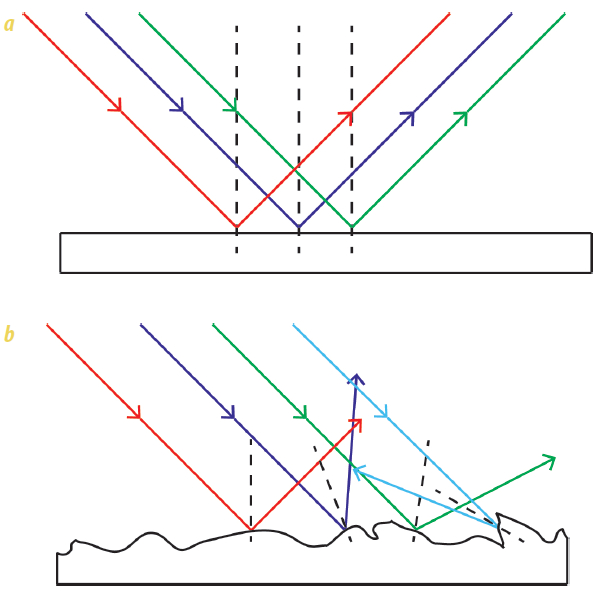
The reflection of light rays from a flat, smooth mirror we dealt with so far is called specular reflection. If, however, light rays hit a plane mirror with a rough surface, we can observe diffuse reflection: The light is reflected back („scattered“) in different directions, as shown in figure b. The law of reflection applies to each of the parallel rays, but because of the unevenness, the rays strike the reflecting surface at completely different angles of incidence. Thus, in contrast to a flat surface, the angles of reflection of the parallel rays no longer coincide and the rays are reflected back in different directions. This is referred to as diffuse reflection.
Watch the following video for more explanations on this effect.
Task 2: In the portfolio, note the similarities and differences of specular and diffuse reflection.
Task 3: In general, one can say: The rougher the surface, the more diffuse the reflection. Give 5 examples of diffuse reflection and rank them according to the degree of diffuse reflection (most diffuse reflection last). Put the reflecting foil into this ranking too.
Task 4: Now think about how the diffuse reflection in the reflactive foil affects you. What kind of feeling does it cause in comparison to the „normal“ mirror? Perhaps this is already a starting point for your own installation.
You can now use your expert knowledge to design the installation!
 Lights on!