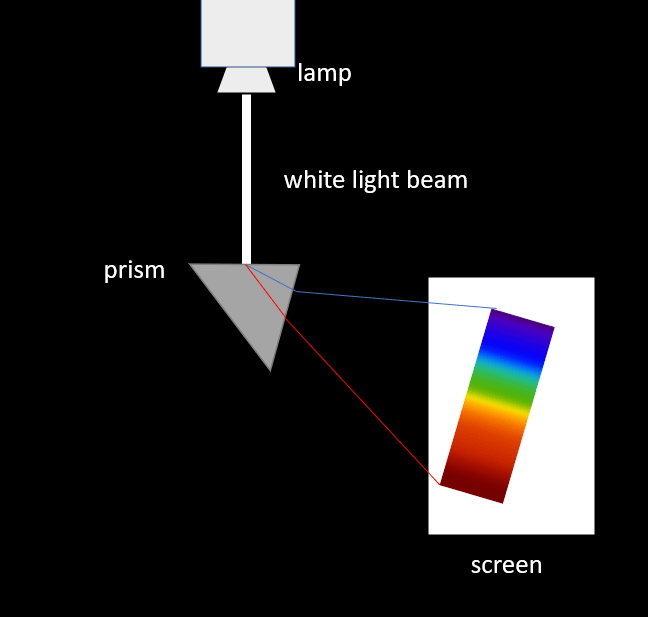
You should have noticed that the light spectrum only appears at a very specific angle, only with a specific arrangement of the three objects. The light does not pass straight through the prism, but is deflected – one also says refracted.
„Refraction is an important term used in the Ray Optics branch of Physics. Refraction of light is defined as the change in direction or the bending of a wave passing from one medium to another due to the change in speed of the wave. Some natural phenomena occurring in nature where refraction of light takes place are the twinkling of stars, the formation of mirages and Rainbows, Optical illusions, and many more. The major cause of refraction to occur is the change in the speed of waves in different mediums, which is different due to the difference between the densities of the mediums. e.g. the speed of light in a vacuum is maximum.
What is Refraction of Light?
The bending of a light wave when it passes from one medium to another due to the change in the speed of the light traveling the two different media is called the Refraction of light.
This phenomenon also occurs with sound, water, and other waves. Because of this bending of waves that are responsible for the refraction of light, we have lenses, magnifying glasses, prisms, and rainbows. Due to this phenomenon, our eyes would not be able to focus, without the refraction of light.
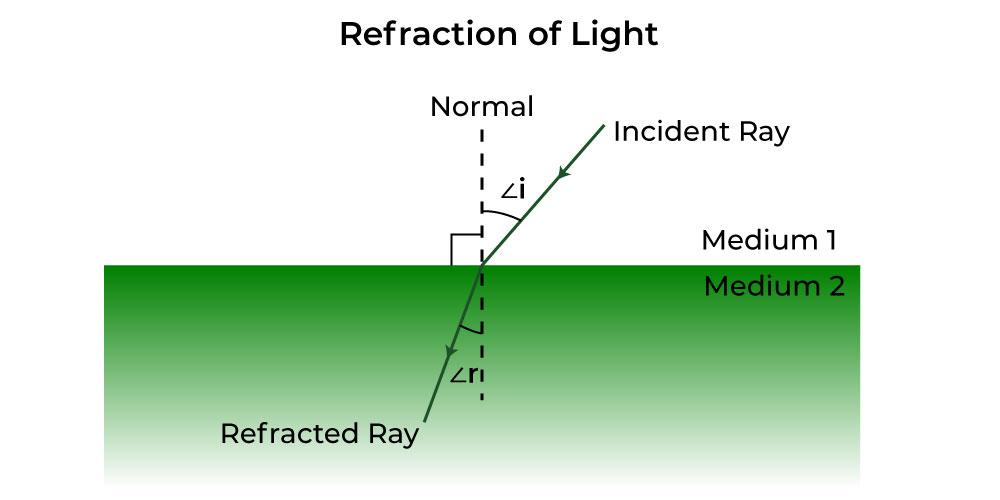
As shown in the above figure, light travels from Medium 1 to Medium 2. Please note that these mediums can be different materials or substances with different densities. So when an incident ray from medium 1 travels to another medium 2, the refracted ray bends either towards the normal or away from the normal (depending upon the densities of the mediums).
Here are the definitions of important terms used to study Refraction:
- Normal – The point of the surface at which an optical phenomenon occurs is called the normal. In simple words, it is termed the point of incidence. It is shown by a dotted line drawn perpendicular to the surface of the refracting material, in a ray diagram.
- Incident Ray – The light rays that strike the refracting surface, at the separation of two media are called the Incident Ray.
- Refracted Ray – The light rays that bend after passing into another medium are called the Refracted Ray.
- Angle of Incidence – This is the angle between the incident ray and the normal. It is represented by ∠i and it is also called an Incident angle.
- Angle of Refraction – This is the angle between refracted ray and the normal. It is represented by ∠r and it is also called a Refracted angle.
What is the Refractive Index?
The Refractice index also called the index of refraction enables us to know how fast light travels through the material medium.
Refractive Index is a dimensionless quantity. For a given material or medium, the refractive index is considered the ratio between the speed of light in a vacuum (c) to the speed of light in the medium (v) on which it goes. The Refractive index for a medium is represented by small n, and it is given by the following formula:
n = c / v
where
- c is the speed of the light in a vacuum, and
- v is the speed of light in the medium.
The given velocities of light in different media can give the refractive index by the following also where the first medium is not vacuum:
n21 = v1 / v2
where n21 is the refractive index of 2 with respect to 1.
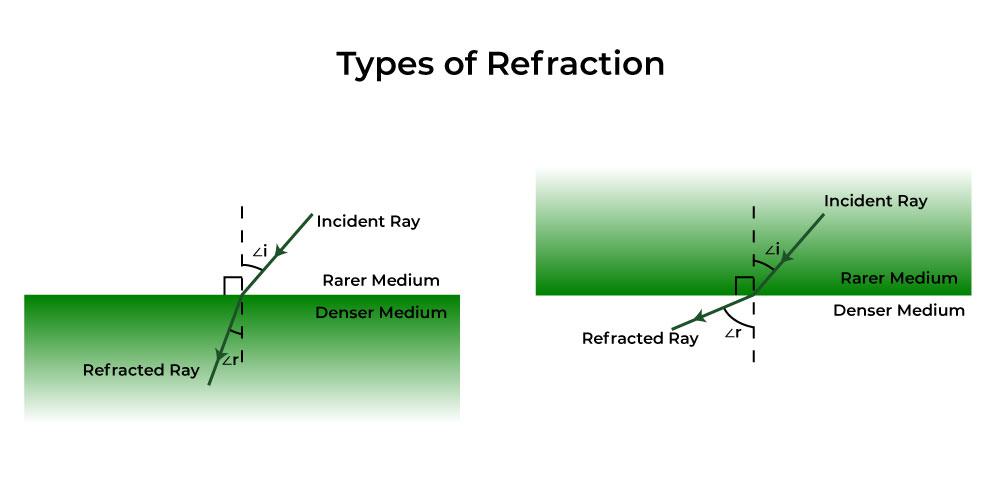
Based on the given refractive index of the material or medium, the light ray either changes its direction or bends at the junction which separates the two given media. If the light ray travels from a certain medium to another of a slightly higher refractive index, it bends towards the normal in that case when traveling from rarer to a denser medium, or else it bends away from the normal when traveling from denser to rarer medium.
What are Rarer and Denser mediums?
- Rarer medium (or Optically Rarer medium) is a medium in which the speed of light is more. For example, Air is optically rarer medium as compared to glass and water.
- Denser medium (or Optically Denser medium) is a medium in which the speed of light is less. For example, Glass is optically denser medium as compared to air.
Types of Refraction
The refraction of light occurs in different ways depending on the medium through which the light travels.
- Refraction from denser to rarer medium – When light rays pass through rarer to a denser medium, the light rays bend towards the normal. Due to this the angle of refraction is smaller than the angle of incidence. e.g. In the case when light rays pass from air to water or from air to glass, it bends towards normal. It is because of the reason that the speed of light rays reduces while passing from air to glass or water.
- Refraction from rarer to denser medium – When light rays pass from denser to rarer medium, the light rays bend away from the normal. Due to this the angle of refraction becomes more than the angle of incidence. e.g. In case when light rays pass from water to air or glass to air, light rays bend away from the normal. The speed of light rays becomes greater while passing from glass or water to air. „
Source: https://www.geeksforgeeks.org/refraction-of-light/
After reading the text, work on the following tasks:
Tasks
Task 1: Complete the two mnemotechnic verses.
- When light is traveling from an optically rarer medium to an optically denser medium, it …
- When light passes from an optically denser medium to an optically rarer medium, it …
Task 2: Copy the following drawing and complete it by labeling the angle of incidence , angle of reflection and angle of refraction. Mark the interface. Label the incident ray, the refrective ray and the reflected ray.
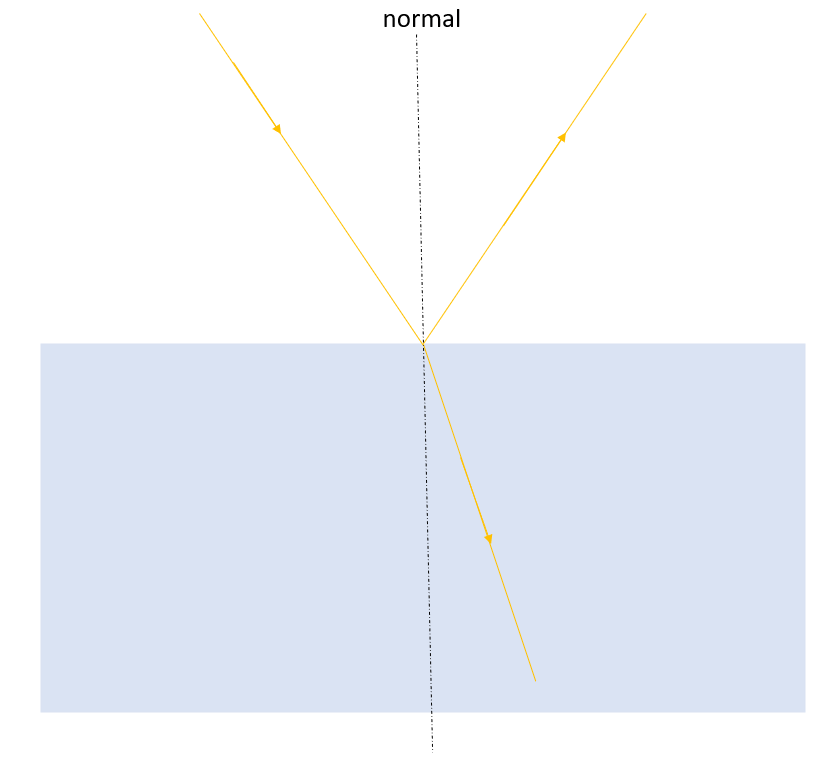
- Which of the two optical media has the higher reflective index? (Hint: no math needed here)
- What is the difference between Reflection and Refraction of light?
Task 3: And how does refraction work with the prism?
Look at the following scetch and use it as well as your knowledge from the video to explain (in writing) why
- …we can only abserve a rainbow in a certain angle to the prism and not in a straight line
- …we see a rainbow behind the prism and no white light (dispersion)
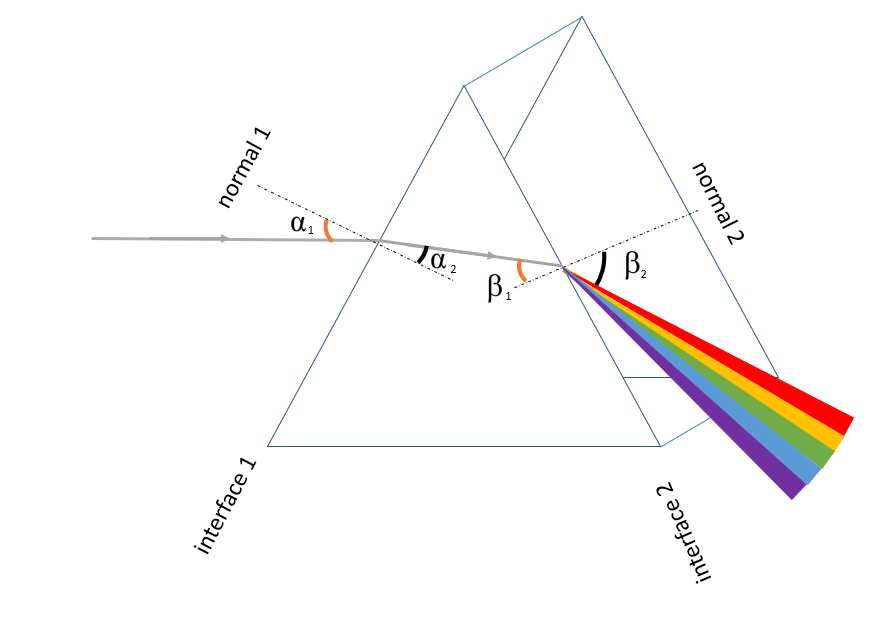
Task 4: Remember task 2? There was an inscidence of reflection, not only refraction. Actually, when all the light is reflected and not at all refracted, it is called Total internal reflection. Read the following section and take notes on the questions:
- What is Total internal reflection?
- What is the critical angle?
- When do both refraction and reflection occur?
„total internal reflection, in physics, complete reflection of a ray of light within a medium such as water or glass from the surrounding surfaces back into the medium. The phenomenon occurs if the angle of incidence is greater than a certain limiting angle, called the critical angle. In general, total internal reflection takes place at the boundary between two transparentmedia when a ray of light in a medium of higher index of refraction approaches the other medium at an angle of incidence greater than the critical angle. For a water-air surface the critical angle is 48.5°. Because indices of refraction depend on wavelength, the critical angle (and hence the angle of total internal reflection) will vary slightly with wavelength and, therefore, with colour. At all angles less than the critical angle, both refraction and reflection occur in varying proportions.“
Source: https://www.britannica.com/science/total-internal-reflection
Task 5: Each group memner on their own shall research the key words „total reflection“ and „diamonds“ combined with a search engine. Explain, how these two key words are related and prepare a small presentation on the topic that includes a sketch and a 3-min-lecture. Present your lecture to the group. After all lectures are presented, you will have to decide for one lecture to be presented to the whole class at the end of the station learning. You may also combine parts you like from your lectures into one.
Refraction and the light spectrum are used by certain artists to create fascinating plays of colour and light. On the next page you will find some examples.
 Lights on!